Holy Land Orthodox Heritage is an independent educational resource devoted to the history, architecture, art and devotional tradition of Eastern Orthodox Christianity in and around Jerusalem and Bethlehem. It is written and maintained by a small editorial team of history and heritage writers. It is not a church body: it does not represent, speak for, or hold any affiliation with any church, congregation, monastic house or religious organisation, in the Holy Land or anywhere else. Everything published here is secondary summary compiled from published scholarship, and every page points onward to the libraries, museums and reference works where the primary material can be read directly.
The subject is both unusually well documented and unusually easy to get wrong. The buildings at its centre have been raised, ruined, patched and raised again across seventeen centuries, and the written record preserves those layers very unevenly. A fourth-century travel diary such as the account left by the pilgrim Egeria, a Byzantine mosaic map and a modern excavation report each see a different fraction of the same fabric. Many of those primary texts survive in translation through collections such as the Internet Medieval Sourcebook. We set out what is securely established, mark plainly where the evidence thins, and keep the description architectural rather than devotional.
Four Strands, One Tradition
The material divides into four strands, and readers tend to arrive looking for one of them. Architecture and archaeology account for the largest share: the shrine churches, the desert houses and the walled city that frames them. Liturgical tradition covers the shape of the church year, the reckoning of its dates and the sung repertory that carries the rite. Art and manuscript culture covers painted panels, wall mosaics, pigments and monastic libraries; pilgrimage history covers the travellers themselves, and what their accounts can be made to tell us.
| Strand | Principal subjects | Chief evidence |
|---|---|---|
| Architecture and archaeology | Shrine churches, monastic houses, walls, street grids | Standing fabric, excavation reports, measured drawings |
| Liturgical tradition | The church year, the Paschal reckoning, Holy Week | Service books, calendars, eyewitness description |
| Art and manuscripts | Panel painting, wall mosaic, pigment, binding, libraries | Surviving objects, museum catalogues, palaeography |
| Pilgrimage history | Routes, itineraries, hospices, the travel-account genre | First-person narratives, maps, inscriptions |
Those strands are not really separable in practice. A mosaic pavement is an archaeological object, an art-historical one and a liturgical one at once, and the best questions sit where two of them overlap. The division is a way through the material, not a statement about how the tradition understands itself.
The Buildings
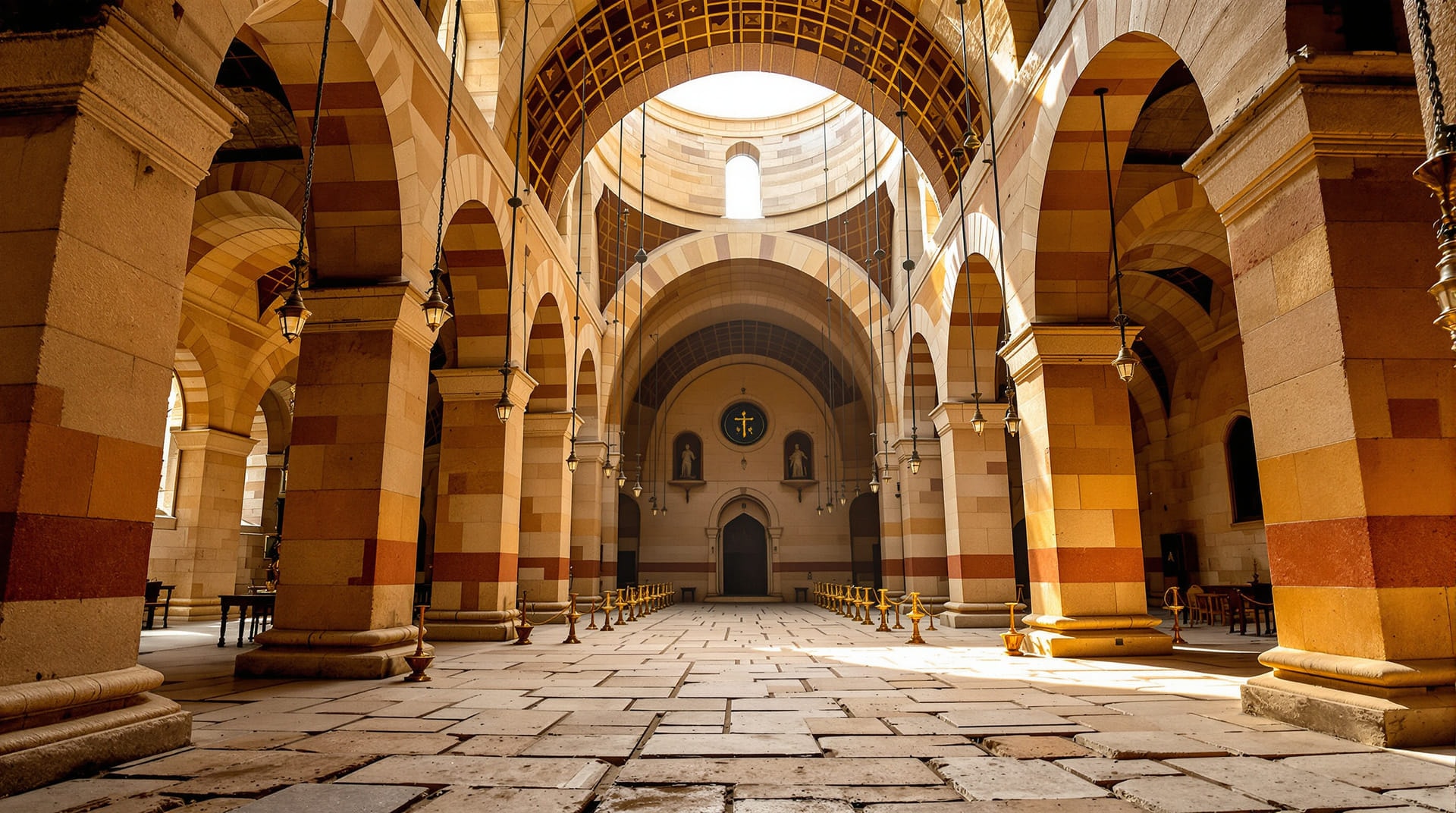
Two churches dominate the subject. The Church of the Holy Sepulchre in Jerusalem is the most heavily rebuilt major monument in the Christian world: a fourth-century foundation, wrecked in the seventh century, demolished in the eleventh, reassembled by Byzantine and then twelfth-century builders, gutted by fire in 1808 and consolidated in the twentieth. The Church of the Nativity at Bethlehem is the opposite case, and the more remarkable one, because it was never destroyed at all: sixth-century colonnades still stand on fourth-century foundations, carrying a roof of medieval design and a mosaic programme laid in the 1160s.
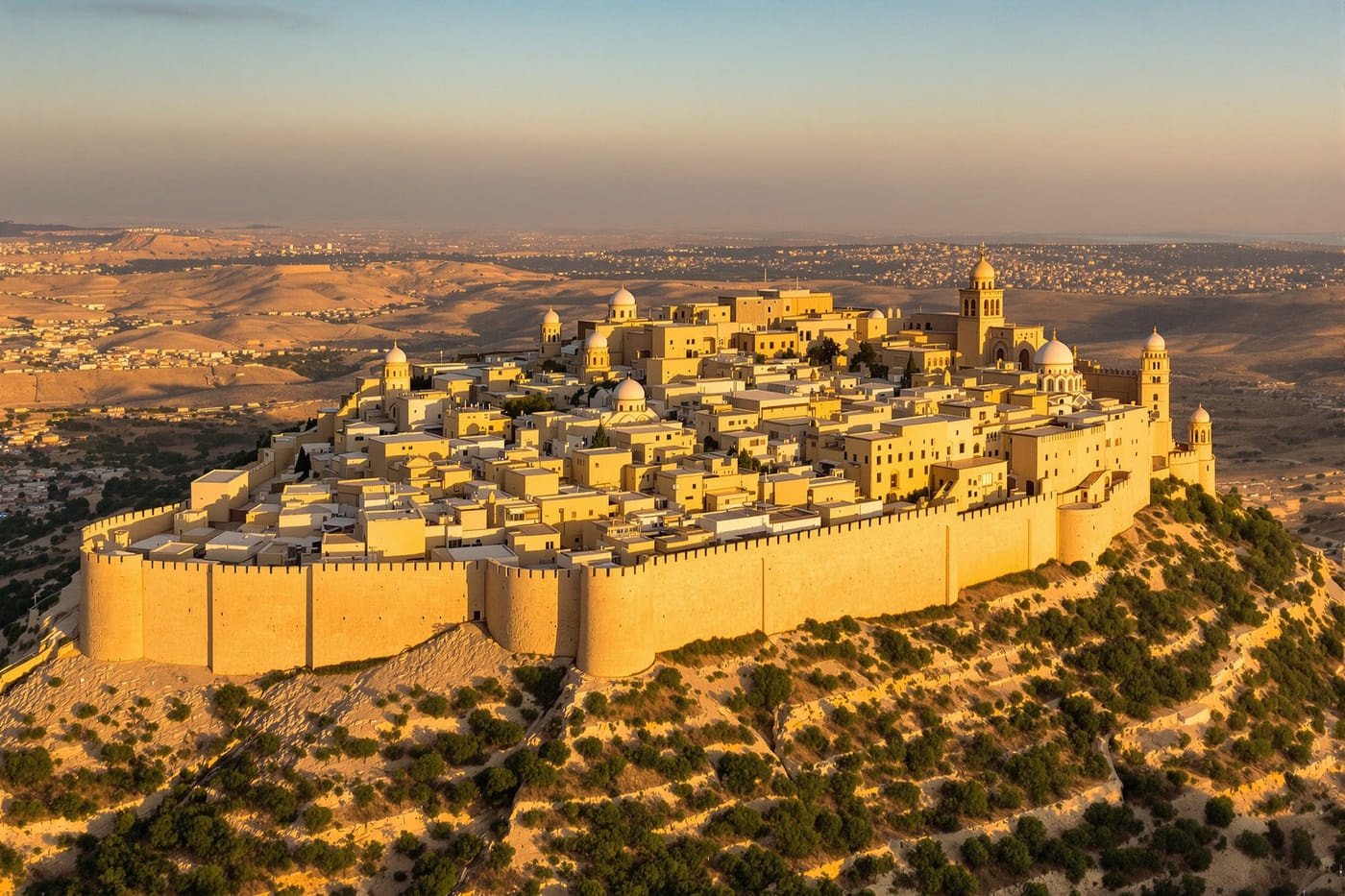
Both buildings sit inside a landscape that shaped them. The walled Old City of Jerusalem preserves a Roman street plan beneath its lanes and a sixteenth-century wall above them, and the routes pilgrims walked between the shrines are legible in both. Beyond the city, the monasteries of the Judean desert occupy cliff ledges and dry watercourses in a building tradition made for a landscape of much stone and almost no water. A wider survey of the shrines and their fabric is set out under the pilgrimage sites of the Holy Land.
Rite, Calendar and Chant
The liturgical strand is where most readers need orientation first. The liturgical calendar explains the Julian reckoning used here for the fixed feasts, the movable cycle governed by the Paschal computation, and why those dates diverge from the civil year. Byzantine chant covers the eight-mode system, its notation, and the way the repertory is bound to the calendar. The Holy Saturday ceremony is treated as a rite of great antiquity described by travellers from at least the ninth century, with each description attributed to the person who wrote it.
Image, Ink and Pigment
Panel painting in the Eastern tradition is a craft with rules, and those rules are the subject of our survey of Byzantine iconography: the preparation of the board, the gesso and gold ground, the sequence of pigment layers, and the conventions of gesture and colour that keep the images legible. The related material culture — Greek and Syriac codices, bindings, metalwork and embroidered textiles — is gathered under manuscripts, libraries and treasury. Readers who want wider artistic context will find the Heilbrunn Timeline of Art History survey of Byzantine art a good companion to what we cover here.
Travellers and Their Records
Almost everything known about how these places looked before the age of measured survey comes from people who went there and wrote it down. Medieval pilgrim accounts range from the terse fourth-century itinerary to the vast fifteenth-century narrative. Some describe fabric that no longer exists, some describe fabric that never existed, and telling the two apart is much of the work. A dated summary of the whole sequence is laid out in the timeline.
Using This Resource
Technical vocabulary is unavoidable here and we have kept it rather than smoothing it away; the glossary defines the architectural and liturgical terms as they are used on these pages. Sources and further reading lists the scholarship each article draws on, and about this resource sets out who writes it and what the site deliberately does not cover. Readers wanting a general orientation will find the Britannica overview of Eastern Orthodoxy a reliable place to begin.